Market Recap
The second quarter of 2026 was a sharp reversal of the first. Just three months ago, the first quarter had delivered a decline of 5% in U.S. stocks, the energy sector was up nearly 38%, software names were down 24%, and there was a genuine fear that a prolonged closure of the Strait of Hormuz could spike oil prices towards $200/barrel. Stagflation reentered the vocabulary, as worries about higher inflation coupled with slowing economic growth seemed like a possible scenario. But what followed in the second quarter was a round trip in risk assets. Domestic stocks rallied into early June to all-time highs ending up 10.2% through June 30. This was despite inflation that has accelerated to a three-year high, a Federal Reserve that is being interpreted as more hawkish, and a war that remains unresolved. But markets are forward-looking, and the rally was in large part a bet that the worst of the energy shock was behind us.
The rotation into foreign equities also continued. Emerging markets led the way, gaining roughly 24% for the second quarter, as the same memory and semiconductor demand driving Korea and Taiwan rewarded the markets most exposed to it. This goes to show that the AI theme is not unique to U.S. markets. Developed international equities had a solid 10.8% return but failed to keep pace with other equity markets. Fixed income offered its own version of the quarter’s round trip. The Federal Reserve made no change to the policy rate—the June meeting marked a fourth consecutive hold at 3.50% to 3.75%. The thirty-year Treasury bond told the more dramatic story, spiking to 5.18% in mid-May (its highest in 19 years) before easing back toward 4.91% at the end of June. The broader bond market returned a modest 0.67% for the quarter. Credit stayed calm during the quarter with high yield bonds gaining 2.5% in the quarter.
Investment Outlook & Portfolio Positioning
No single variable shaped the past two quarters more than the conflict in the Middle East. A loosely held ceasefire took effect in early April, culminating in a memorandum of understanding announced in mid-June. The market’s response was swift and one-directional. Brent crude, which had peaked at $118/barrel in late April, fell about 26% in May back into the mid-$80s. By the end of the quarter, Brent was trading near $73, the lowest level since late February and roughly back to where prices sat before the war started. The conflict in the Middle East is far from a settled matter and fragile. The oil market is a risk worth watching closely because much of the disinflation story of the second half rests on it.
The inflation data released during the quarter told the story of the energy shock working through the system with its usual lag. In May, the Federal Reserve’s preferred gauge, the core personal consumption expenditures index, reached 3.4% year-over-year, the highest since October 2023. Falling oil prices should provide some reprieve to prices in the coming months; however, we are closely watching core inflation, and any sustained move higher would be worrisome for markets. Strip out energy and the picture is far calmer. This is consistent with the view we expressed in our first quarter commentary, that the 2026 inflation episode is fundamentally a supply-driven energy shock rather than a repeat of the broad, demand-driven inflation of 2022. The distinction matters because supply shocks, painful as they are, tend to reverse when the supply returns. With oil having round-tripped back near pre-war levels, the near-term peak in inflation is likely behind us and inflation expectations eased meaningfully.
At new Fed Chair Kevin Warsh’s first meeting, the committee held the federal funds rate steady at 3.50% to 3.75% by a unanimous vote, but delivered an upward revision to both the committee’s inflation and Federal funds rate expectations. The median projection for the federal funds rate at the end of 2026 moved up to 3.8% from 3.4% in March, an implied rate hike rather than cuts. The dollar rallied and gold sold off. By the end of the quarter, markets had moved to price a meaningful probability of a rate hike by October and a strong likelihood of one by December—a complete reversal of the easing narrative that was present at the start of the year.
The key driver of the rally in the second quarter was artificial intelligence, much like it has been for the last few years. The amount of capital being invested by the hyperscalers and its impact all the way to local economies is difficult to overstate. Over the course of the spring, the largest technology platform companies raised their capital expenditure guidance, and the combined planned spend over the next 12 months is now nearly $850 billion. In most cases, capital spending is being funded out of free cash flow rather than debt. However, significant equity and debt issuance during the second quarter marks a divergence from internal cash flows funding the CAPEX. This trend is something to monitor, as well as the return on invested capital these companies actually realize – a possible precursor of challenges ahead in parts of the tech sector.
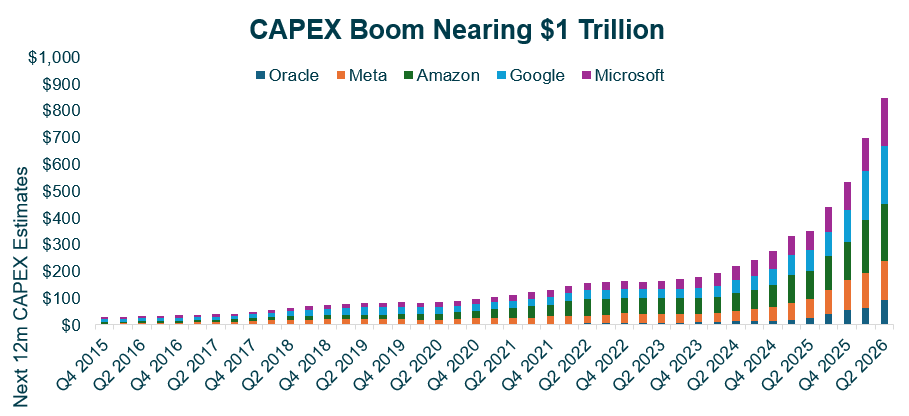
Source: Bloomberg LP. Data as of 6/30/2026
Despite the huge CAPEX spend, the quarter also reminded investors how much risk is concentrated in this handful of names. The Magnificent Seven now represents nearly one-third of the entire S&P 500, a historic level of concentration. The forward price-to-earnings multiple on the index sits near 21x, above its five- and ten-year averages, and that premium is overwhelmingly a function of these few stocks. We do not read valuation measures as timing signals—expensive markets can become more expensive—but as a statement about the long-run return one can reasonably expect from the index at today’s starting point.
For all the recent volatility in the AI trade, the broad market held up nicely because something was working beneath the mega-cap surface: the equal-weighted index, small caps, and previously unloved sectors began to carry their fair share in the final weeks of June. There are risks of an index whose fortunes rest on a handful of names, and the beginning of a genuine broadening is exactly what a durable bull market requires. It is difficult to declare that leadership has permanently changed, but the late-quarter rotation is a welcome development. As for the credit market, it does not corroborate any stress in the markets. When spreads are this tight, investors are being paid very little to take on credit risk, and the asymmetry is unattractive: there is limited room for spreads to compress further. However, all-in yields for corporate bonds above 5% offer nice current income—especially when you consider where we’ve been in recent years. We favor moving up in quality and shortening duration relative to the broader bond market.
We find ourselves at the midpoint of 2026 looking at a market and economy that has remained resilient despite numerous things to worry about. Markets sit near record highs, and having done so while inflation reached a three-year high, the Federal Reserve pivoted from contemplating cuts to projecting hikes, and a war shut off the key transportation route for many energy commodities. The market has chosen to look through all of it. Our base case is constructive but disciplined. If the truce holds and energy markets remain contained, inflation should continue to recede from its recent peak, the consumer should regain some confidence, and the solid earnings growth can continue. In that environment, in our opinion, the most attractive opportunities are not in the names that have already run the furthest but in the broadening we observed later in the second quarter. Our portfolios maintain exposure further down in market capitalization and are more value-oriented when compared to market-cap-weighted indexes. This is not a call against technology stocks or against artificial intelligence, both of which we expect to remain central to the market for years. It is more a recognition that the risk and reward in the most crowded parts of the market is unbalanced, and that diversification, which felt like a drag during the past few years, will be rewarded. In fixed income, the hawkish turn at the Fed and the pressure at the long end argue for keeping duration underweight, while using the higher absolute yields now available to be selective where the compensation is adequate.
Closing Thoughts
As mentioned, we would frame the path ahead around a few key markers – inflation, the Iran conflict and the AI buildout. Uncertainty exists, but as the second quarter sent markets to record highs despite numerous unresolved risks, it reminds us that markets tend to confound investors. What seems like the “likely” scenario is often different than what actually plays out. This calls for staying invested — earnings growth and the economy still support that — but also for staying diversified, because the concentration at the top of the market is a vulnerability and the broadening beneath it is an opportunity. We thank you for your continued trust and partnership. Please also find enclosed the economic newsletter from Dr. Ray Perryman.
The Water Valley Investment Team